
South Korean Won Strengthens After President Lee Jae‑Myung’s Exchange Rate Target Comments
Introduction
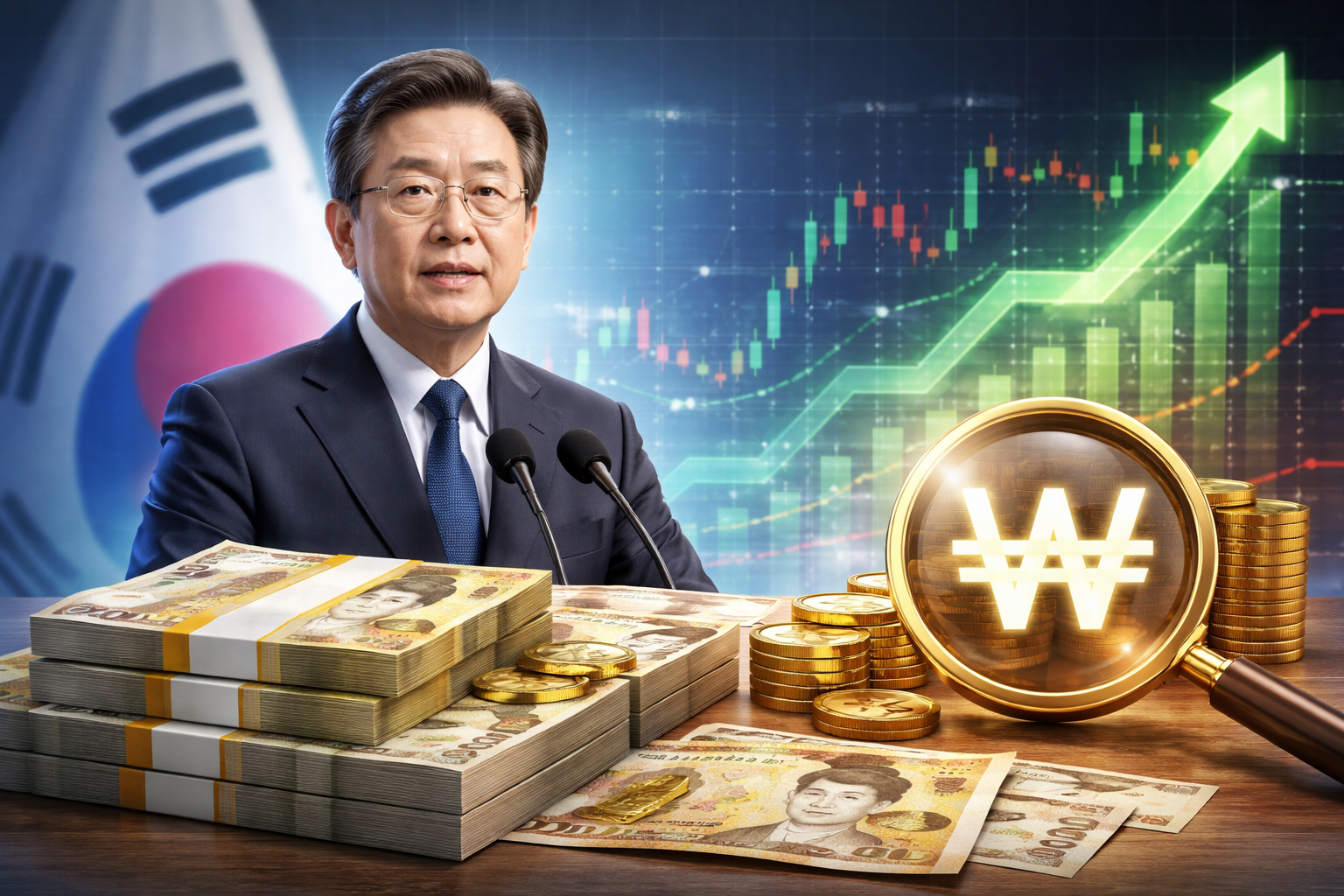
On January 21, 2026, South Korea’s foreign exchange market experienced a notable reaction following unusually explicit remarks by President Lee Jae‑myung regarding the trajectory of the won‑dollar exchange rate. In what many analysts called a form of verbal intervention, President Lee projected that the won would strengthen toward approximately 1,400 won per U.S. dollar within the next one to two months. These remarks came amid a period of sustained won weakness, market volatility, and broader geopolitical and economic dynamics influencing currency markets.
President Lee’s Remarks: Breaking Convention
Traditionally, South Korean authorities—including the central bank and finance ministry—have avoided publicly stating specific exchange rate forecasts or target levels. Exchange rate policy typically relies on broad goals such as stability and fundamental alignment rather than explicit numeric targets.
However, at a press conference on January 21, President Lee articulated a concrete projection that the foreign exchange rate should “fall to around 1,400 won per dollar in about one to two months.” This level, far lower than the prevailing market rates in mid‑January, represented both a normative expectation and political signaling to markets that authorities want to see the won strengthen over the short term.
Market participants interpreted this as an unprecedented form of “verbal intervention”, where the mere content of official remarks influences trading behavior without direct market operations. Immediately following Lee’s statement, the won strengthened sharply, reversing earlier intra‑day weakness—an indication that traders were willing to unwind some of their long dollar positions after hearing the president’s comments.
Market Reaction: Immediate Strengthening Of The Won
On the day of the comments, the won opened around 1,480.4 per dollar, briefly weakened, and then gained sharply, reaching around 1,468.7 won per dollar after Lee’s remarks before closing the trading session stronger than earlier in the week. This reversal marked the first weekly strengthening of the won since January 15, when U.S. Treasury interventions briefly bolstered market confidence regarding the currency.
Such price action underscores how market psychology and official guidance are critical in foreign exchange dynamics, especially in times of volatility. Currencies are not only assets driven by interest rates, trade balances, or capital flows; they are also sensitive to expectations and sentiment. When a head of state publicly states a desired outcome with a timeline, even if purely aspirational, it can anchor market expectations and trigger short‑term movements.
What Drove The Won’s Weakness Before The Comments?
To understand why President Lee’s remarks were so striking, it’s important to revisit the market context and structural conditions that preceded them.
Persistent Depreciation
Leading up to January 21, the Korean won had been weak relative to the U.S. dollar, climbing back into the high 1,400 range. On January 13, reports noted the won weakening past the 1,470 mark and nearing multi‑year lows—levels not seen in many years.
This depreciation reflected multiple factors:
Capital outflows as investors sought U.S. assets and dollar positions amid global uncertainty.
Strong U.S. economic performance and higher interest rates compared with South Korea’s relatively stagnant interest environment.
The weaker Japanese yen, which exerted regional FX influence and made the won’s relative depreciation more pronounced.
Retail investor behavior, including increased overseas stock investments, boosting demand for dollars.
External geopolitical pressures, such as tariff threats and global risk sentiment shifts, that lifted demand for safe‑haven currencies like the dollar.
Structural and Behavioral Drivers
Economists and analysts have pointed to longer‑term variables also contributing to the won’s weakness. One factor is the increased global buying of dollar‑denominated assets by South Korean institutional investors, including the National Pension Service, which has lifted demand for dollars relative to won. Another is the supply‑demand imbalance in FX markets, where domestic liquidity did not translate into consistent won buying, even as authorities attempted interventions.
These dynamics made the won’s weakness not purely a short‑term cyclical issue, but a manifestation of broader structural flows and investor preferences.
Policy Tools And Government Measures
In response to the deprecation trend, South Korea’s authorities implemented a suite of policies to support the won, though with varying degrees of transparency and intensity.
Verbal and Strategic Interventions
The most visible policy response has been verbal intervention, both by domestic officials and international counterparts. For example, U.S. Treasury Secretary Scott Bessent commented that the won’s weakness was “not in line with Korea’s strong economic fundamentals,” signaling international concern over excessive volatility.
President Lee’s remarks can also be seen as part of this verbal strategy—aimed at shaping expectations and market sentiment rather than directly adjusting policy levers.
Hedging and Tax‑related Measures
Authorities have also promoted strategic hedging operations, particularly through state institutions like the National Pension Service, to manage currency risk. In addition, tax incentives were introduced to encourage retail investors to rebalance away from foreign stock investments back into domestic assets. These measures attempted to address the demand side of dollar flows.
Limitations and Challenges
Despite these efforts, analysts noted that policymakers alone cannot easily steer exchange rates purely with intent or limited tools. Exchange rates are influenced by global capital flows, comparative interest rate dynamics, geopolitical developments, and investor behavior. Although policy statements can shift expectations, they do not always translate into sustained economic fundamentals.
Broader Economic Context: Stocks And Foreign Exchange
While the FX market showed volatility, South Korea’s equity markets flourished. The KOSPI stock index surged to record levels, nearing and breaking historical highs. This divergence between a buoyant stock market and a weakening currency highlights the complex interplay between asset classes in the Korean economy. Strong stock performance, driven in part by gains in semiconductors and technology sectors, can attract or repel foreign capital in different ways than currency markets. Stocks may benefit from corporate performance and global growth narratives, while currencies respond to interest rate differentials, macroeconomic expectations, and foreign exchange flows that do not always align with equity performance.
Analysis: What Lee’s Comments Mean For Markets
President Lee’s explicit exchange rate targeting comments carry multiple implications:
Policy signaling matters: Verbal interventions by top leaders can alter short‑term market positioning, but they are no substitute for robust policy frameworks addressing underlying economic forces.
Markets seek anchors: When fundamentals are uncertain, markets gravitate to signals from official sources. By stating a numeric target and timeframe, Lee essentially provided an anchor that traders could use to adjust positions.
Risk of credibility questions: Some economists caution that providing specific numeric targets can backfire if markets do not converge toward them, potentially reducing policymaker credibility.
Limits of domestic policy: The administration acknowledged that domestic measures alone may be insufficient, especially when regional currency trends (like the yen’s movement) and global dollar strength are prevalent.
Structural Challenges And Future Risks
Despite short‑term FX stabilization, South Korea faces deeper structural issues:
- Capital flows remain volatile, especially as investors seek yield and safety in a global context dominated by U.S. financial conditions.
- Interest rate differentials between Korea and the U.S. or Japan could sustain pressure on the won if domestic rates lag.
- Geopolitical and tariff uncertainties add risk premium to emerging market currencies like the won.
- Investor behavior trends, including foreign equity selling and overseas investments, may be slow to reverse even with incentives.
Conclusion
President Lee Jae‑myung’s direct comments on the won’s exchange rate mark a notable shift in South Korea’s policy communication style, reflecting heightened concern over currency volatility. The immediate strengthening of the won underscores that markets are listening. Yet policymakers and investors alike must recognize the limits of verbal guidance and focus on strengthening economic fundamentals, managing capital flows, and engaging in international coordination where necessary.
While the projection of a 1,400 won per dollar rate within months was a bold statement, the true test will be whether this projection aligns with broader economic developments and whether policymakers can maintain credibility while navigating complex global financial conditions.